
What If Your AI Agents Could Actually Work as a Team?
One AI agent is useful. Ten AI agents working in parallel is chaos — unless they can communicate, coordinate tasks, and follow a hierarchy.
Flightdeck gives your AI agents the infrastructure to collaborate. Messaging, task management, role-based delegation — the same things that make human teams work, built for AI crews.
And here's the meta part: Flightdeck was built by a team of AI agents, orchestrated through Flightdeck itself. A PM agent wrote specs. A designer agent created the UX. Developer agents wrote code. A QA agent tested with Playwright. The tool coordinated its own construction.
The Problem: Multi-Agent = Chaos Without Coordination
You tell an AI to "build a feature." It spawns 8 agents. They all start coding — in complete isolation. No shared context, no structured communication. Two of them edit the same file without knowing. A third rewrites what the fourth just finished. A critical task sits unstarted because no one was assigned it. By default, agents work in silos. They don't coordinate because they have no way to.
More agents doesn't mean more output — not without coordination.
The Solution: Give Your Agents Communication, Tasks, and Hierarchy
Flightdeck is an orchestration layer for multi-agent AI systems. It provides three things agents need to work as a team:
💬 Communication & Messaging
Agents need to talk to each other — not just to you.
- Direct messages — agent-to-agent communication, queued so it doesn't interrupt ongoing work
- Group chats — agents form topic-specific groups to coordinate on shared concerns (API design, naming conventions, architecture decisions)
- Broadcasts — one agent can announce to the entire crew
- Priority routing — your messages always go to the front of the queue
When the architect needs to align with three developers on an interface, they create a group chat. Everyone sees the same context. No telephone game, no duplicated conversations.
📋 Task DAG
A flat to-do list doesn't work when tasks have dependencies. Flightdeck uses a directed acyclic graph (DAG) — tasks know what they depend on and what's blocking them.
- Auto-created — when a lead delegates work, DAG items appear automatically
- Dependency tracking — Task B waits until Task A completes
- Critical path — see which tasks are blocking the most downstream work
- Status flow — ready → running → done/failed, visible to the entire crew
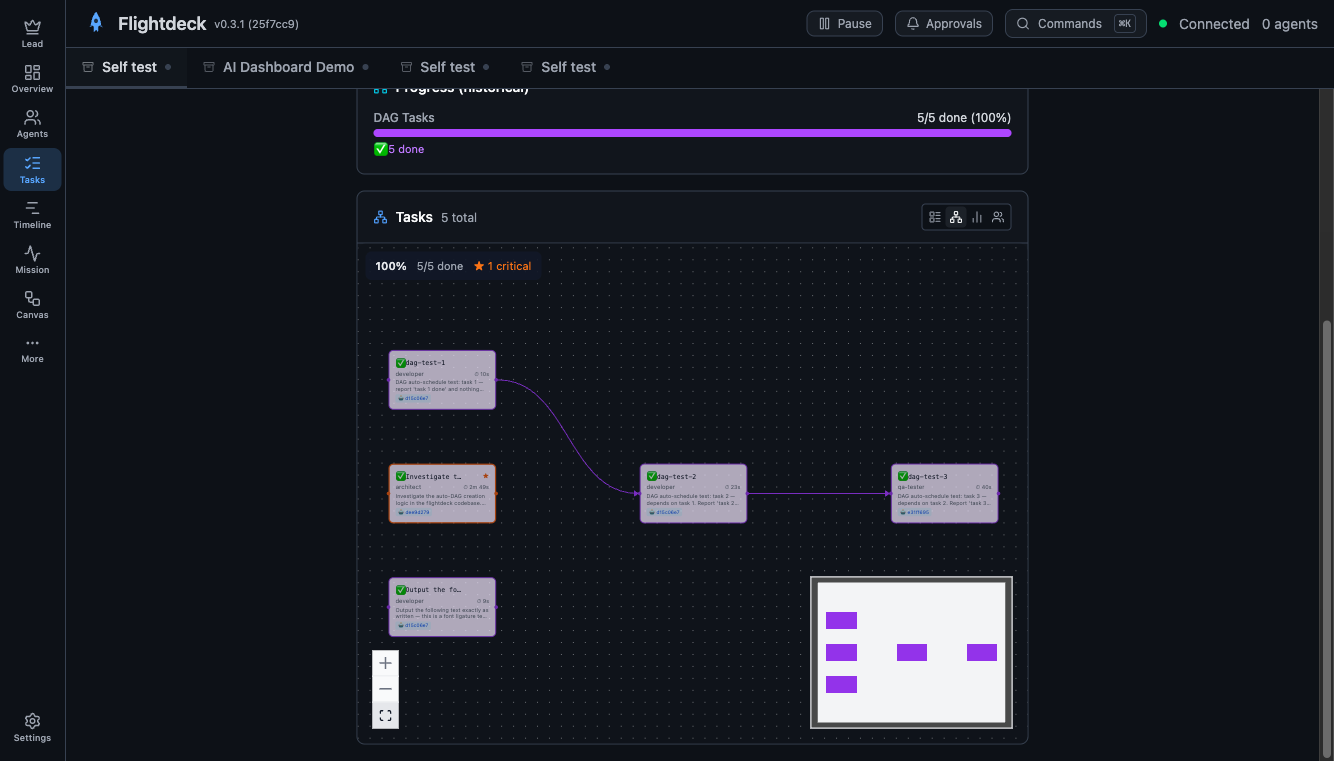
The lead says "build the settings page." Flightdeck creates tasks for the component, the API endpoint, the tests, and the docs — with the right dependency order. The developer can't start integration tests until the API is built. The DAG enforces that.
👥 Collaboration Hierarchy
Not every agent should do everything. Flightdeck provides role-based structure:
- Project Lead — analyzes the goal, creates the plan, delegates to specialists, reviews results
- Specialized roles — Developer, Architect, Code Reviewer, Designer, QA Tester, Technical Writer, and more
- Right model for the right job — use fast/cheap models for exploration, powerful models for architecture decisions
- Report-back flow — agents complete tasks and report to the lead, who synthesizes the result
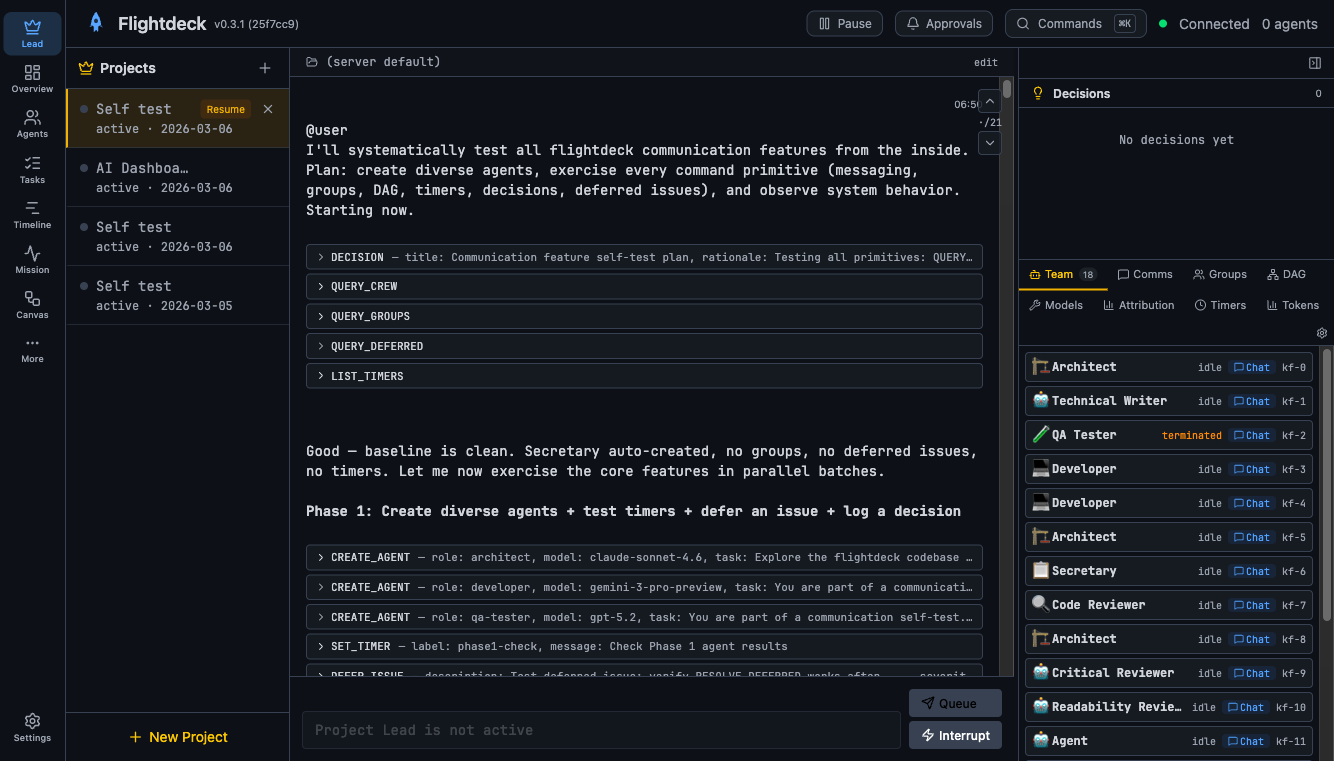
This isn't one AI doing everything. It's a structured team where the architect designs, the developers build, the reviewer catches bugs, and the QA tester runs the code end-to-end.
See It All Unfold
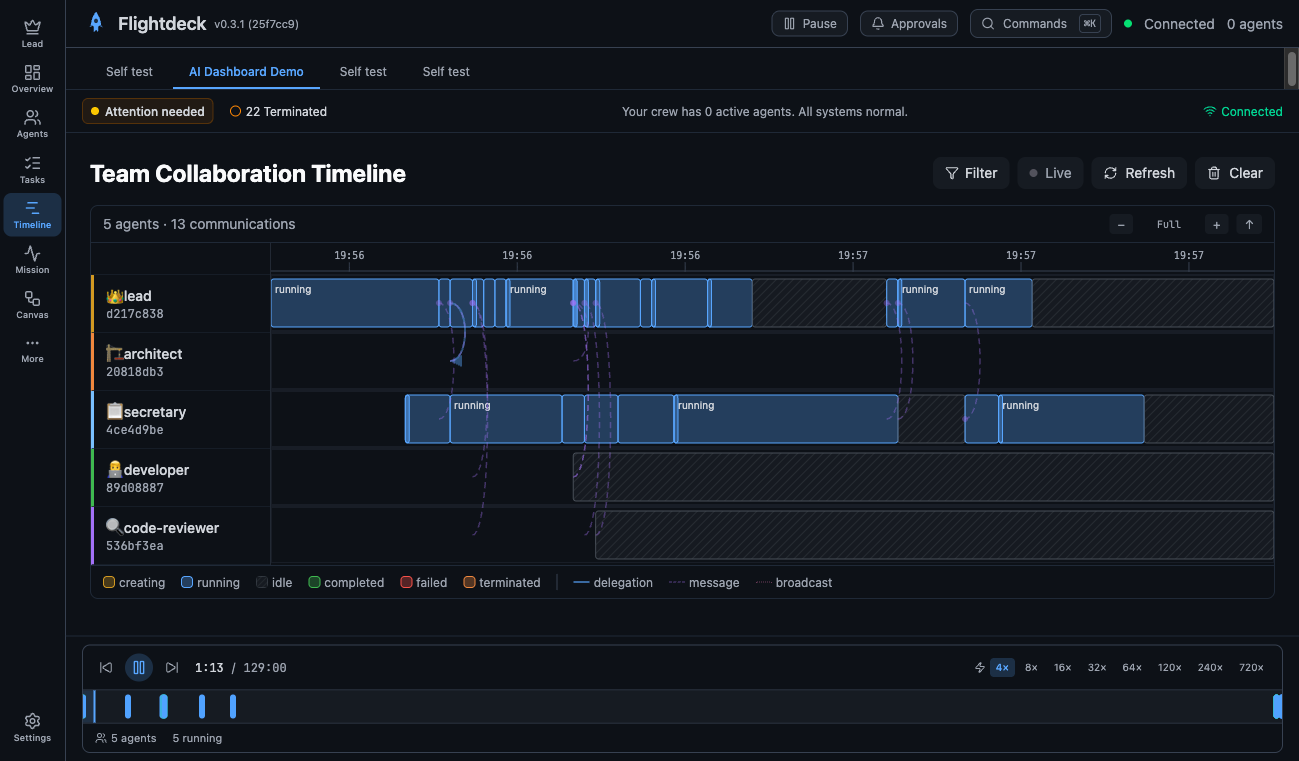
Orchestration produces a natural side effect: visibility. When agents communicate through Flightdeck, you can see every message, every task transition, every delegation.
- Timeline — swim-lane Gantt chart showing what each agent did and when
- Session Replay — scrub through past sessions at up to 32× to review how the team coordinated
- Overview — cumulative flow, agent activity heatmaps, and context usage at a glance
The Proof: We Built This With This
Flightdeck v0.3.0 was built by a crew of 10+ AI agents orchestrated through Flightdeck:
- The Product Manager agent defined feature specs and wrote launch copy
- The Architect agent designed the component hierarchy and data flow
- Developer agents implemented features in parallel, coordinating via group chats
- The Code Reviewer agent caught bugs before they shipped
- The QA Tester agent ran Playwright tests against the live UI
- The Technical Writer agent wrote the docs you're reading right now
They messaged each other. They formed groups to debate design decisions. They tracked tasks in a DAG. They filed issues, reviewed each other's work, and shipped — all coordinated through the same tool they were building.
🚀 Get Started in 60 Seconds
npm install -g @flightdeck-ai/flightdeck
flightdeck
That's it. No config files, no API keys. Runs locally on SQLite — your data stays on your machine.
⭐ Star on GitHub: github.com/justinchuby/flightdeck
📖 Read the docs: Quickstart Guide
Open source · MIT License · Built with React, TypeScript, Express, and SQLite.